
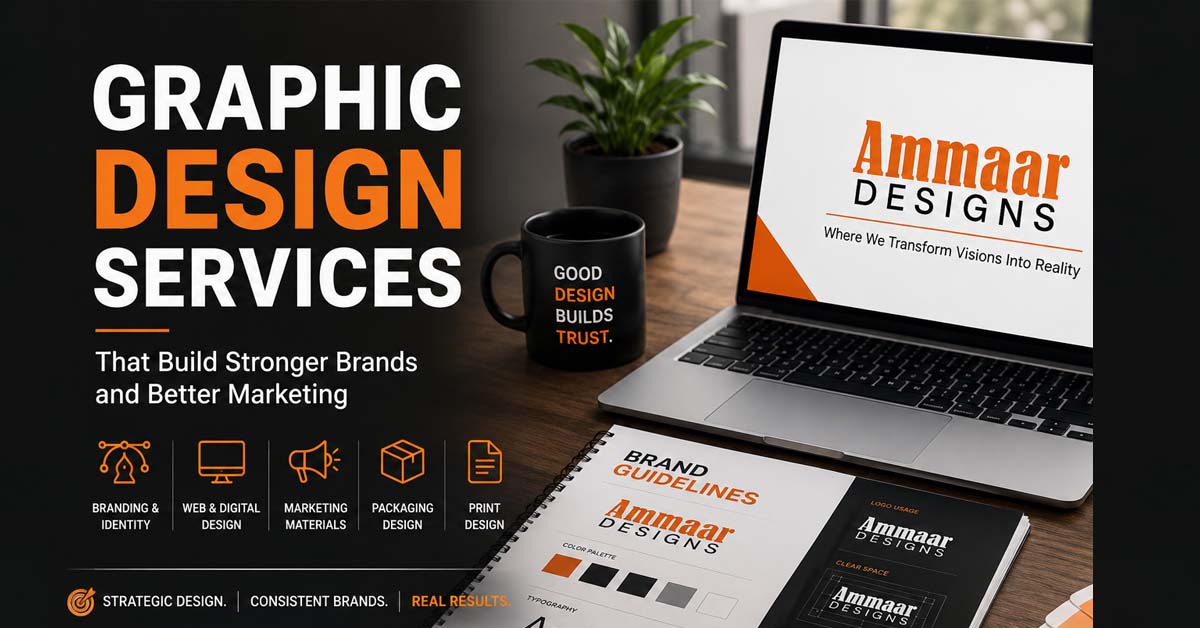
A business can spend thousands on advertising and still struggle to attract customers if the design fails to communicate trust. Customers judge brands within seconds. Logo design, brand identity, website design, packaging, and marketing materials all shape that judgment.
Graphic design services help businesses create a consistent visual identity across every customer touchpoint. Professional graphic design combines brand strategy, visual hierarchy, typography, color theory, and user-focused communication to make marketing easier to understand and harder to ignore.
The most effective graphic design services do more than make a brand look attractive. Graphic design services help businesses build recognition, support marketing campaigns, improve customer trust, and create consistency across digital and print channels.
This guide covers the graphic design services that drive business growth, signs your business has outgrown its current design, how to evaluate a graphic design agency, and how AmmaarDesigns approaches branding and visual communication projects.
Most businesses need more than a logo
Many business owners believe branding starts and ends with a logo. A logo is one component of a visual identity system. A logo alone cannot create consistency across advertisements, social media graphics, packaging, presentations, websites, and printed materials.
Businesses often face branding problems after launching a logo. Marketing materials start to look different from one campaign to another. Social media posts lack consistency. Sales presentations use different fonts and colors. Customers struggle to recognize the brand across channels.
The result is fragmented communication. Every marketing asset competes with the others instead of reinforcing the same message.
Why design problems usually start with brand inconsistency
Brand inconsistency creates confusion.
A customer might see a social media advertisement with one color palette, visit a website with another visual style, and receive marketing materials that look completely different. Each inconsistency weakens recognition.
Strong brands maintain consistency across every visual asset. The logo, typography, color palette, photography style, layouts, and messaging work together as one system.
Large brands invest heavily in brand identity guidelines for this reason. Companies do not create detailed brand standards because they enjoy documentation. Companies create standards because consistency improves recognition.
Brand identity design establishes rules for visual communication. Those rules help businesses maintain a professional appearance across all customer interactions.
How poor design affects marketing, sales, and customer trust
Poor design creates friction.
Customers hesitate when a business appears unprofessional. Trust drops when marketing materials look outdated or inconsistent. Advertising performance suffers when visuals fail to communicate value.
Poor graphic design can affect:
- Brand recognition
- Customer trust
- Advertising performance
- Website engagement
- Conversion rates
- Sales presentations
- Product perception
A restaurant with poorly designed menus may appear less professional than competitors. An e-commerce brand with weak packaging may struggle to justify premium pricing. A service business with inconsistent branding may appear less established than competitors offering similar services.
Design influences perception before customers evaluate products, services, or pricing.
The difference between hiring a designer and building a visual brand
Hiring a designer and building a visual brand are not the same thing.
A designer can create a logo, flyer, brochure, or social media graphic. A visual brand creates a system that connects every asset.
Businesses that focus only on individual design projects often accumulate disconnected visuals over time. Businesses that focus on brand systems create stronger recognition and more consistent marketing.
A visual brand includes:
- Logo design
- Brand identity design
- Typography systems
- Color systems
- Marketing templates
- Website design standards
- Brand guidelines
The strongest brands treat graphic design as an ongoing business investment rather than a one-time creative task.
The graphic design services that have the biggest business impact
Not every graphic design service delivers the same value. Some services influence brand recognition. Others improve marketing performance or customer experience.
The following graphic design services have the greatest impact on business growth.
Logo design services
Logo design creates the visual foundation of a brand.
A professional logo should be memorable, scalable, versatile, and relevant to the business it represents. Effective logo design focuses on recognition rather than complexity.
Many of the most recognizable logos in the world rely on simplicity. Designers such as Paul Rand and Saul Bass built identities that remain recognizable decades later because clarity outperforms decoration.
A professional logo design process typically includes:
- Research
- Concept development
- Sketch exploration
- Vector refinement
- Logo variations
- Brand applications
The final deliverable should work across websites, social media, packaging, signage, advertising, and printed materials.
Brand identity design
Brand identity design extends beyond the logo.
A brand identity establishes how a business looks and communicates across every customer touchpoint. Strong brand identity services help businesses appear consistent regardless of platform or format.
Color systems
Color influences perception.
Different colors communicate different attributes. Blue often communicates trust. Black often communicates authority. Green often communicates growth or sustainability.
Brand identity design defines primary, secondary, and supporting colors that work together across marketing materials.
Color systems help businesses maintain consistency across websites, advertisements, packaging, presentations, and social media graphics.
Typography systems
Typography affects readability and perception.
A luxury brand requires different typography than a technology startup. A law firm requires different typography than a restaurant.
Typography systems define:
- Primary fonts
- Secondary fonts
- Heading styles
- Body text styles
- Hierarchy rules
Consistent typography improves recognition and creates a professional appearance across all marketing channels.
Brand guidelines
Brand guidelines document how visual assets should be used.
Brand guidelines help teams, designers, marketers, and printers maintain consistency.
Typical brand guidelines include:
- Logo usage
- Color specifications
- Typography rules
- Image styles
- Layout standards
- Brand applications
Without guidelines, maintaining consistency becomes difficult as a business grows.
Marketing design services
Marketing design services support customer acquisition and brand awareness.
Businesses use marketing design across digital and print channels to communicate products, services, and promotions.
Social media graphics
Social media platforms compete for attention.
Businesses need consistent graphics that support brand recognition while communicating messages clearly.
Social media graphics may include:
- Promotional posts
- Product announcements
- Educational content
- Event promotions
- Campaign visuals
Well-designed graphics improve visibility and reinforce brand identity.
Advertising creatives
Advertising creatives influence campaign performance.
Design affects click-through rates, engagement, and conversion potential. Effective advertising creatives communicate value quickly while maintaining brand consistency.
Advertising design includes:
- Display ads
- Social media ads
- Banner ads
- Campaign graphics
- Retargeting visuals
Strong advertising design combines marketing strategy with visual communication.
Brochures and flyers
Printed marketing materials remain valuable in many industries.
Brochure design services help businesses communicate information in a structured format. Flyer design services support promotions, events, product launches, and local marketing campaigns.
Clear layouts, visual hierarchy, and concise messaging improve effectiveness.
Packaging design services
Packaging influences buying decisions.
Customers often evaluate products before reading descriptions. Packaging design shapes expectations about quality, value, and positioning.
Packaging design services typically include:
- Product packaging concepts
- Label design
- Box design
- Print production files
- Packaging mockups
Businesses selling physical products benefit from packaging that supports recognition and shelf visibility.
Website and landing page design
A website functions as a digital storefront. Poor design creates friction. Strong website design improves navigation, readability, and conversions.
Website graphic design focuses on:
- Layout structure
- Visual hierarchy
- User experience design (UX)
- Mobile responsiveness
- Conversion-focused elements
Businesses investing in digital marketing often benefit from landing pages designed around specific campaigns and goals.
Corporate and business documents
Many businesses overlook internal and corporate design materials.
Professional corporate design services include:
- Company profiles
- Business presentations
- Proposal templates
- Business cards
- Letterheads
- Corporate reports
Consistent business documents strengthen credibility during client meetings, proposals, and sales presentations.
Signs your business has outgrown its current design
Businesses rarely notice design problems immediately. Design systems often break down gradually as companies add new products, launch marketing campaigns, hire different designers, or enter new markets.
Growth exposes weaknesses that were easy to ignore during the early stages of a business.
The following signs indicate that your current design no longer supports your business goals.
Customers recognize competitors more than your brand
Brand recognition affects marketing efficiency.
A customer who immediately recognizes your logo, colors, and visual style requires less effort to convert than a customer seeing your brand for the first time.
Weak recognition usually appears when:
- Visual styles change frequently
- Marketing campaigns lack consistency
- Brand assets vary across channels
- Different teams use different design standards
Competitors with consistent branding often appear larger, more established, and more trustworthy, even when products and services are similar.
Recognition compounds over time. Every consistent customer interaction strengthens memory and trust.
Marketing materials look disconnected
Marketing assets should look like they belong to the same business.
Many companies accumulate design assets from different designers, freelancers, agencies, and internal teams. The result is a collection of materials that communicate different visual messages.
Common examples include:
- Social media graphics using different fonts
- Advertisements that ignore brand colors
- Presentations that look unrelated to the website
- Brochures that use outdated branding
- Landing pages that feel disconnected from advertising campaigns
Customers notice inconsistency even when they cannot explain why something feels off.
A disconnected visual identity weakens credibility and reduces the effectiveness of marketing investments.
Your visuals no longer match your pricing or positioning
Design influences perceived value.
Businesses often increase prices, improve service quality, or target a different market segment while keeping the same branding they launched years earlier.
The mismatch becomes obvious.
A premium service paired with outdated visuals creates doubt. High-end products presented through low-quality packaging reduce perceived value. Professional expertise loses impact when marketing materials appear amateur.
Visual positioning should support business positioning.
Businesses serving premium markets need branding that reflects the expectations of premium buyers.
Design requests keep producing inconsistent results
Every new project should not require reinventing the brand.
Businesses without clear design systems often face recurring problems:
- Different logo usage across materials
- Inconsistent typography
- Changing color palettes
- Conflicting visual styles
- Repeated design revisions
These problems increase costs and slow production.
Strong brand systems create consistency before the design process begins. Designers can work faster because standards already exist.
Consistency becomes easier to scale when clear rules guide every project.
What separates effective graphic design from decoration
Many businesses judge design based on appearance alone.
Attractive visuals matter, but visual appeal is only one part of effective graphic design. Design should support business goals, communicate information clearly, and help customers make decisions.
Decoration attracts attention.
Effective design guides attention.
Design should support business goals
Every design project should solve a specific business problem.
A logo should improve recognition.
Packaging should improve product perception.
A landing page should support conversions.
Advertising creatives should communicate value quickly.
Businesses achieve better results when design decisions connect to measurable objectives.
Before starting a project, designers should understand:
- Target audience
- Business goals
- Market position
- Customer expectations
- Marketing strategy
Design becomes more effective when creative decisions support commercial objectives.
Consistency matters more than complexity
Many businesses assume better design means more detail. The opposite is often true. Strong brands rely on consistency rather than complexity.
Global brands maintain recognizable visual systems because customers encounter the same colors, typography, layouts, and visual language repeatedly.
Consistency improves:
- Brand recognition
- Customer trust
- Marketing efficiency
- Internal collaboration
Simple design systems often outperform complex visual styles because they are easier to apply across multiple channels.
A recognizable brand identity creates more value than a visually impressive design that changes with every campaign.
Good design reduces friction and improves recognition
Customers process visual information quickly.
Effective design helps customers find information, understand offers, and navigate experiences without confusion.
Visual hierarchy plays a major role in this process.
Visual hierarchy determines:
- What customers notice first
- What customers notice second
- What customers ignore
Designers use typography, spacing, color contrast, layout structure, and imagery to direct attention.
Good design removes unnecessary obstacles.
Customers should not struggle to find pricing, contact information, product details, or calls to action.
Clear communication improves user experience and strengthens business results.
How to evaluate graphic design services before hiring
Choosing a graphic design partner affects branding, marketing, and long-term business growth.
Many businesses evaluate designers based only on portfolio appearance. Attractive visuals matter, but successful projects depend on more than aesthetics.
The evaluation process should focus on strategy, communication, and business understanding.
Review work across multiple industries
A portfolio reveals how a designer thinks.
Look for diversity rather than repetition.
Strong graphic designers adapt their approach to different industries while maintaining quality standards.
Review projects across:
- Professional services
- Retail businesses
- Food brands
- Technology companies
- Real estate businesses
- E-commerce brands
A varied portfolio demonstrates problem-solving ability rather than reliance on one design style.
Look beyond attractive visuals
A beautiful design does not guarantee business results.
Ask questions such as:
- What problem did the project solve?
- What audience was the design created for?
- How does the design support business goals?
- How was success measured?
The answers often reveal more than the visuals themselves.
Strong designers explain the reasoning behind their decisions.
Assess their branding process
A professional graphic design process should include research and planning.
Projects that skip discovery often produce weaker results.
A branding process may include:
- Business analysis
- Competitor review
- Audience research
- Creative direction
- Concept development
- Refinement stages
Process creates consistency.
Businesses that invest in strategy often receive stronger long-term outcomes.
Check whether they understand marketing
Graphic design and marketing work together.
Designers who understand marketing create assets that support customer acquisition and sales efforts.
Marketing awareness helps designers:
- Improve communication
- Support advertising campaigns
- Create stronger landing pages
- Build more effective brand systems
Design decisions become more valuable when they align with broader business objectives.
Compare long-term value instead of project cost
Price matters.
Value matters more.
A low-cost logo that requires replacement within a year becomes expensive. A well-developed brand identity can support marketing efforts for years.
Evaluate providers based on:
- Quality
- Experience
- Process
- Strategic thinking
- Communication
- Long-term support
The lowest quote rarely delivers the highest value.
Businesses should view graphic design as an investment in brand equity rather than a short-term expense.
How AmmaarDesigns approaches graphic design projects
Many design projects fail before the first concept is created. The problem is not creativity. The problem is the lack of direction. Businesses often request a logo, brochure, website, or social media graphics without identifying the business objectives behind the project. The result is a design that looks acceptable but fails to support growth, recognition, or marketing performance.
At AmmaarDesigns, every project starts with understanding the business before creating visual assets. The goal is not to produce isolated designs. The goal is to create visual communication that supports brand positioning, customer perception, and marketing objectives.
Brand-first thinking
Every design decision communicates something about a business. Color choices, typography, layouts, imagery, and messaging all influence how customers perceive a brand.
A logo without a strategy becomes a graphic. A brand identity built around positioning becomes a business asset.
Before developing visual concepts, the focus should be on understanding:
- Target audience
- Market position
- Competitive landscape
- Business goals
- Customer expectations
- Brand personality
This approach helps ensure that design decisions align with business objectives rather than personal preferences.
For example, a luxury real estate company requires a different visual identity than a fast-food brand. A law firm requires different typography and communication standards than an e-commerce startup. Design should reflect the expectations of the audience rather than trends that happen to be popular at the time.
Design built around business objectives
Effective graphic design should help a business achieve measurable outcomes.
A branding project should improve recognition.
A website design project should improve user experience and conversion opportunities.
Marketing materials should support lead generation and customer acquisition.
Packaging should strengthen product perception and improve shelf visibility.
Each project requires a different approach because each business has different objectives. The design process should identify those objectives early and use them to guide creative decisions.
This prevents projects from becoming subjective debates about colors or visual preferences. Instead, design decisions are evaluated based on how effectively they support business goals.
Consistent systems, not isolated assets
One of the most common branding problems occurs when businesses create assets independently without considering how those assets work together.
A logo is designed by one provider.
The website was created by another.
Social media graphics follow a different style.
Marketing materials use unrelated typography and colors.
The result is inconsistency.
Customers experience the brand through dozens of touchpoints. Every interaction should reinforce the same visual identity.
Strong branding relies on systems rather than individual assets. A brand identity should provide clear standards for colors, typography, imagery, spacing, layouts, and visual communication. These standards help maintain consistency as marketing efforts expand across platforms.
Businesses that build systems instead of isolated assets often achieve stronger recognition and more efficient marketing.
Support across branding, web design, and marketing
Modern businesses rarely need only one design service.
A new company may require logo design, brand identity development, website design, social media graphics, and marketing materials.
An established business may need a rebrand, packaging redesign, advertising creatives, and updated corporate documents.
Working across multiple disciplines creates stronger alignment between branding and marketing. Design assets support one another rather than competing for attention.
This integrated approach helps businesses maintain consistency across every customer touchpoint while reducing the inefficiencies that often occur when multiple providers work independently.
Graphic design services FAQ
What are graphic design services?
Graphic design services help businesses create visual assets such as logos, brand identities, marketing materials, packaging, websites, and advertising creatives that improve communication and brand recognition.
Which design services should a new business prioritize?
Most new businesses should start with a logo, brand identity, website, and core marketing materials. These assets create a consistent foundation for future growth.
How much do professional design services cost?
Costs vary based on project scope, deliverables, and complexity. A complete brand identity requires more time and planning than a single design asset.
Should I hire a freelancer or an agency?
Freelancers work well for smaller projects. Agencies are often a better fit when businesses need branding, marketing, web design, and ongoing creative support under one roof.
How do I choose the right design partner?
Review their portfolio, understand their process, assess their strategic thinking, and evaluate whether they understand your industry, audience, and business goals.
Summary
A strong brand requires more than a logo. Businesses need a consistent visual identity that supports marketing, builds trust, and improves recognition across every customer touchpoint. This article explains the design services that have the greatest impact on business growth, signs your branding may be holding you back, how to evaluate a design partner, and the factors that separate strategic design from visual decoration. You’ll also learn how AmmaarDesigns approaches branding projects with a focus on consistency, business objectives, and long-term brand value.