
Design trends change every year, but not every trend creates value. Some trends improve communication, strengthen brand recognition, and help businesses perform better across websites, social media, advertising, and packaging. Other trends generate attention for a short period before making brands look outdated.
The graphic design trends shaping 2026 are less about decoration and more about clarity. Businesses are competing for attention in crowded digital spaces where customers make decisions within seconds. A design system must communicate quickly, remain recognizable across platforms, and support business goals without sacrificing usability.
This shift is changing how brands approach typography, visual identity, motion content, illustration, and even artificial intelligence. Companies are becoming more selective about which trends they adopt. Instead of redesigning entire identities every year, successful brands are integrating trends into existing systems while protecting recognition and consistency.
The businesses gaining attention in 2026 are not following every trend. They are choosing the trends that improve communication, strengthen positioning, and support long-term growth.
What the Brands Dominating 2026 All Have in Common
The strongest brands in 2026 share one characteristic. They are easy to recognize.
Customers encounter hundreds of marketing messages every day. Social media feeds, websites, search results, video platforms, and digital advertisements compete for the same attention. In this environment, recognition creates a competitive advantage.
Many businesses believe standing out requires complexity. The opposite is happening. Brands are simplifying communication, strengthening visual systems, and focusing on elements that customers can remember.
The companies attracting attention are not necessarily the loudest. They are often the most consistent. Customers recognize their typography, color systems, layouts, imagery, and overall visual identity without needing to see a logo every time.
Clarity Is Replacing Complexity
Complex design often creates friction. A customer should understand the main message within seconds. Large blocks of text, excessive visual effects, and cluttered layouts slow that process. Businesses are reducing unnecessary design elements and prioritizing communication.
This trend is visible across websites, social media graphics, advertising campaigns, and product packaging. Designers are using stronger hierarchy, cleaner layouts, and clearer typography to improve readability.
Mobile devices continue to influence this shift. A design that works on a desktop monitor may fail on a smartphone screen. Brands are simplifying visual systems to ensure messages remain effective regardless of screen size.
Clarity does not mean removing personality. It means every design element serves a purpose.
Recognition Is Outperforming Decoration
Recognition creates trust. Customers become familiar with visual systems through repetition. The more consistently a brand presents itself, the easier it becomes to remember.
Many companies make the mistake of changing visual styles too frequently. A different aesthetic for every campaign may feel creative internally, but it often weakens recognition externally.
The brands performing best in 2026 are investing in systems rather than isolated assets. They create guidelines for typography, colors, layouts, imagery, and messaging. These standards ensure consistency across every customer touchpoint.
Recognition compounds over time. Every consistent interaction strengthens memory and improves recall.
The Graphic Design Trends Shaping Brands in 2026
Several trends are influencing modern branding, marketing, and visual communication. The most successful trends are not gaining popularity because they look different. They are gaining popularity because they solve communication problems.
Bold Typography Becomes the Primary Visual Element
Typography is becoming one of the most important tools in modern design.
Many brands are reducing their reliance on decorative graphics and using typography as the central visual element. Strong headlines communicate messages faster than complex illustrations or abstract visuals.
Typography-focused layouts work particularly well across digital platforms where attention spans are short and competition is intense.
Why Large Type Captures Attention Faster
Large typography creates immediate hierarchy. Customers naturally notice larger elements before smaller ones. Brands are using this behavior to guide attention toward important messages.
Large type improves readability across mobile devices and social media platforms. It helps brands communicate value quickly without relying on excessive supporting elements. Typography-driven designs often perform well because they prioritize communication over decoration.
Where Businesses Are Using It
Technology companies use bold typography to simplify technical messaging.
Service businesses use typography-focused layouts to communicate expertise and credibility.
E-commerce brands use strong type systems for promotions, product launches, and seasonal campaigns.
This trend works particularly well when paired with simple layouts and strong contrast.
Minimalist Branding Evolves Beyond Simple Logos
Minimalism is no longer limited to logo design. Brands are extending minimalist principles across entire identity systems. The focus has shifted toward creating visual systems that are easier to manage, scale, and recognize.
Cleaner Brand Systems
Businesses are reducing unnecessary design elements across websites, advertising campaigns, packaging, and social media content.
Cleaner systems improve consistency. They make it easier for internal teams, designers, and marketers to create assets that align with the brand.
A well-structured system reduces confusion and creates a stronger customer experience.
Higher Contrast and Stronger Recognition
Minimalist branding in 2026 relies on stronger contrast than previous years.
Brands are using bold color combinations, clear typography, and decisive visual hierarchy to increase visibility. This approach improves recognition while maintaining simplicity.
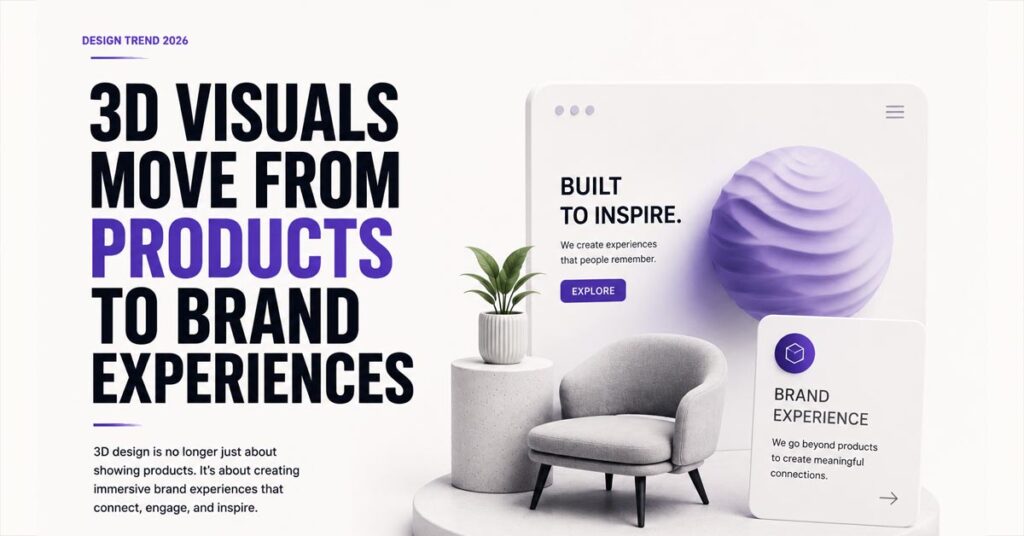
3D Visuals Move From Products to Brand Experiences
Three-dimensional design is expanding beyond product rendering. Brands are using 3D visuals throughout advertising campaigns, websites, packaging systems, and digital experiences.
Packaging Applications
Packaging design is becoming more immersive through 3D visualization. Brands can showcase products before production, test concepts, and create marketing assets from the same visual system.
Advertising Applications
Advertising campaigns increasingly use 3D elements to create depth and visual interest.
Three-dimensional graphics help products stand out in crowded digital environments while maintaining a modern appearance.
Website Applications
Websites are incorporating interactive 3D elements to improve engagement and create stronger visual experiences.
When used carefully, 3D content can improve storytelling and product presentation without sacrificing usability.
Motion-First Content Becomes a Branding Requirement
Static content remains important, but motion is becoming a larger part of brand communication.
Short-form video platforms continue to influence customer expectations. Audiences increasingly expect movement, transitions, and dynamic content.
Social Media Applications
Motion graphics help brands capture attention in crowded feeds.
Animated typography, subtle transitions, and moving visual elements often outperform static graphics in engagement-focused environments.
Paid Advertising Applications
Motion-based advertising creates additional opportunities to communicate value.
Brands can demonstrate products, highlight services, and guide attention more effectively through movement.
Website Interactions
Modern websites are incorporating subtle animation to improve navigation and user experience. Motion should support usability rather than distract from it.
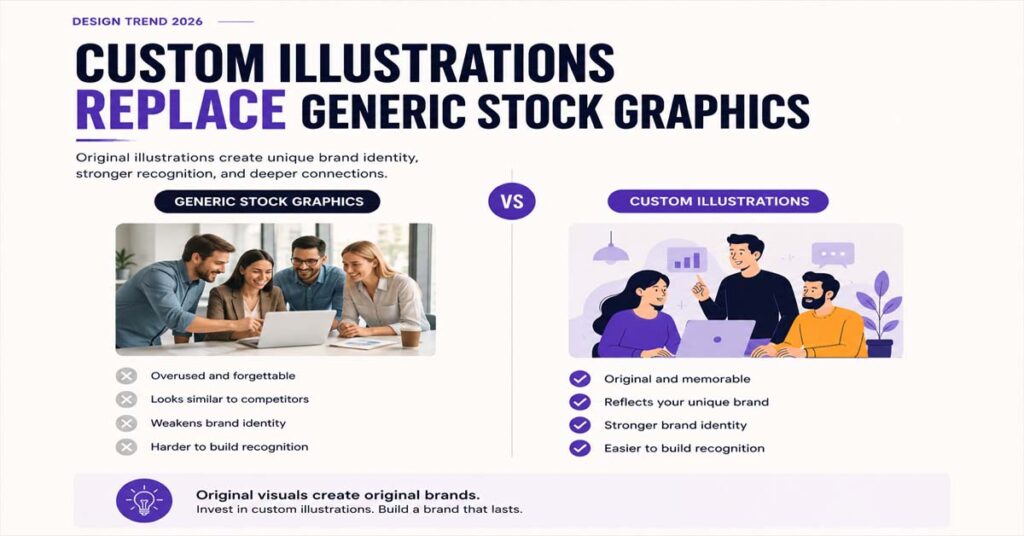
Custom Illustrations Replace Generic Stock Graphics
Building a Distinct Visual Identity
Custom illustrations create ownership. A business using unique visual assets is easier to recognize than a competitor relying on widely available stock graphics.
Illustration styles can become part of a brand’s identity system.
Improving Brand Memorability
Memorable brands create visual associations. Custom illustrations help businesses develop unique visual language that customers can identify more easily over time.
AI-Assisted Design Workflows Become Standard
Artificial intelligence is changing how designers work. Tools such as Adobe Firefly, Midjourney, DALL-E, and Canva AI are accelerating production processes and helping teams generate concepts more efficiently.
The role of AI is expanding, but strategic design decisions still depend on human judgment.
Tasks AI Handles Effectively
AI performs well in areas such as:
- Concept generation
- Image creation
- Background removal
- Asset variations
- Content resizing
- Workflow automation
These capabilities reduce production time and improve efficiency.
Where Strategic Design Still Requires Humans
Brand positioning requires human understanding. Customer psychology requires human understanding. Business objectives require human understanding.
AI can generate visuals, but AI cannot replace strategic thinking, market knowledge, creative direction, or business decision-making.
The strongest design teams in 2026 are using AI as a production tool rather than a replacement for expertise.
The Design Trends Businesses Should Stop Following
Not every popular design trend deserves adoption. Some trends attract attention because they are new, not because they improve communication. Businesses that follow trends without evaluating their purpose often weaken brand recognition and create inconsistent customer experiences.
The most effective brands in 2026 are not adopting every new aesthetic. They are removing the trends that create friction and focusing on the ones that support clarity, recognition, and business goals.
Overcomplicated Logo Systems
Many brands spent the past decade experimenting with intricate logos, layered symbols, hidden meanings, and highly detailed visual marks. The problem is scalability.
Modern logos must work across mobile apps, social media profiles, websites, packaging, presentations, and digital advertising. Complex logo systems often lose clarity when displayed at smaller sizes.
Customers rarely spend time analyzing logo details. Customers need to recognize a logo quickly.
Brands are moving toward simpler marks that maintain their identity while improving usability across digital environments.
Generic Stock-Photo Branding
Stock photography remains useful, but businesses relying entirely on generic visuals face a growing problem. Customers see the same images repeatedly across industries.
A law firm, marketing agency, real estate company, and software startup may all use similar stock photography. This creates visual sameness and makes differentiation difficult.
Brands are investing more heavily in:
- Custom photography
- Original illustrations
- Brand-specific visual systems
- Unique creative assets
Distinct visuals create stronger recognition and help businesses build their own visual territory.
Visual Effects With No Strategic Purpose
Design software makes visual effects easy to create.
Glows, gradients, distortions, shadows, textures, and animated effects can add interest when used intentionally. Problems appear when effects become the primary focus of the design.
Many brands are moving away from excessive visual treatments because they distract from communication. A design should communicate first.
Visual effects should support the message rather than compete with it. The most successful design systems in 2026 use effects selectively and strategically.
Copying Competitors Instead of Building Distinction
One of the fastest ways to weaken a brand is to imitate competitors. Businesses often see a successful company using a particular style and assume copying that style will produce similar results. The opposite often happens. When multiple brands adopt the same visual language, differentiation disappears.
Customers struggle to remember which brand offered which product or service. Strong brands study competitors to identify opportunities for distinction rather than opportunities for imitation. Recognition grows when businesses develop their own visual identity instead of borrowing someone else’s.
Which Design Trends Fit Your Business Stage
Not every trend is suitable for every business. A startup launching its first brand identity faces different challenges than an established company with years of market recognition. Businesses should evaluate trends based on their stage of growth rather than popularity.
New Businesses
New businesses should prioritize recognition before experimentation. The goal during the early stages is to establish a clear visual identity that customers can remember. Consistency matters more than trend adoption.
The most valuable trends for new businesses include:
- Strong typography systems
- Clear visual hierarchy
- Simplified brand identity systems
- Custom visual assets
- Mobile-friendly design approaches
These trends improve recognition without creating unnecessary complexity.
Growing Businesses
Growing businesses have greater flexibility. Once customers begin recognizing the brand, design systems can evolve through additional visual elements, motion content, expanded illustration systems, and more sophisticated marketing assets.
Growing companies often benefit from:
- Motion graphics
- 3D product visualization
- Enhanced advertising creatives
- Expanded content systems
- Stronger digital experiences
The focus should remain on strengthening recognition rather than replacing existing brand equity.
Established Brands
Established brands possess a valuable asset: familiarity. Customers already recognize their visual identity. Major changes introduce risk. For established brands, trends should be integrated carefully.
Successful updates often include:
- Refined typography
- Improved digital experiences
- Updated content systems
- Modernized visual assets
- Enhanced motion design
Incremental improvement often produces better results than complete redesigns.
How To Adopt Trends Without Weakening Your Brand
Trends can improve a brand, but poor implementation can create confusion. Businesses should treat trends as tools rather than identities.
The goal is not to look trendy. The goal is to communicate more effectively.
Protect Recognition Before Introducing Change
Brand recognition takes years to build. Major visual changes should preserve the elements customers already associate with the business. Colors, typography, logos, and visual structures often carry significant recognition value.
Brands should identify which assets contribute most to recognition before introducing updates. This approach allows businesses to evolve without losing familiarity.
Update Systems Instead Of Isolated Assets
Many companies redesign one element while leaving the rest of the visual system unchanged. This creates inconsistency.
A modern website paired with outdated advertising materials creates a disconnect. Updated social media graphics paired with old presentation templates weaken consistency.
Businesses should evaluate branding as a complete system rather than a collection of individual assets. System-wide improvements create stronger customer experiences and improve long-term consistency.
Test Trends Before Scaling Them
Testing reduces risk. Businesses can introduce trends through specific campaigns, landing pages, advertising assets, or limited content initiatives before applying changes across the entire brand.
This process helps identify what resonates with customers and what should remain unchanged.
Small experiments often reveal valuable insights without requiring large-scale redesign efforts.
How AmmaarDesigns Applies Modern Design Trends
Design trends should support business objectives, not replace them.
At AmmaarDesigns, trend evaluation begins with one question: does this trend improve communication, recognition, or customer experience?
If the answer is no, the trend is not worth adopting.
Trend Awareness Without Trend Dependency
Every year introduces new styles, techniques, and creative approaches. Some trends create lasting value. Others disappear within months.
The goal is not to chase trends. The goal is to understand which trends align with business objectives and customer expectations.
This approach helps brands remain current without becoming dependent on temporary aesthetics.
Design Decisions Guided By Business Goals
- Design should support measurable outcomes.
- Branding should improve recognition.
- Advertising should improve engagement.
- Packaging should improve product perception.
- Websites should improve user experience.
Every visual decision should connect to a specific objective rather than personal preference.
Creating Brands Built For Long-Term Recognition
Long-term recognition requires consistency. Businesses gain more value from recognizable visual systems than from constantly changing aesthetics. Trends can improve those systems when applied carefully, but they should never replace the foundations that customers already recognize.
The strongest brands adapt while remaining familiar. That balance creates trust, consistency, and long-term brand value.
Strong Brands Outlast Design Trends
Design trends will continue to change. Some will become industry standards. Others will disappear as quickly as they arrived. Businesses that focus exclusively on trends often find themselves redesigning repeatedly without building meaningful recognition.
The brands succeeding in 2026 are taking a different approach. They are using trends selectively, strengthening visual systems, improving communication, and maintaining consistency across every customer touchpoint. Typography, motion design, custom illustrations, 3D experiences, and AI-assisted workflows all have value when they support broader business objectives.
Strong brands are not built through trend adoption alone. Strong brands are built through recognition, consistency, and clear communication. Businesses that prioritize those principles will continue to perform well long after today’s trends are replaced by tomorrow’s.
Graphic Design Trends 2026 FAQ
What Is The Biggest Graphic Design Trend In 2026?
The biggest trend is the shift toward clarity. Brands are simplifying visual systems, strengthening typography, and focusing on recognition rather than decoration.
Are Minimalist Logos Still Effective?
Yes. Minimalist logos remain effective when they are supported by strong brand identity systems, typography, and visual consistency.
Is AI Replacing Graphic Designers?
No. AI improves production efficiency and concept generation, but strategic thinking, brand development, creative direction, and business understanding still require human expertise.
How Often Should A Business Refresh Its Branding?
Most businesses should refine their branding as customer expectations, technology, and market conditions evolve. Major redesigns should happen only when there is a clear business reason.